Receiving the ZI-WBK Award, LSF Does Not Become Complacent
Jakarta, 12 February 2026 — After successfully receiving the Integrity Zone Award towards a Corruption-Free Area (ZI-WBK) from the Ministry of Administrative and Bureaucratic Reform (PAN-RB), the Indonesian Film Censorship Board (LSF RI) stated that it does not become complacent.
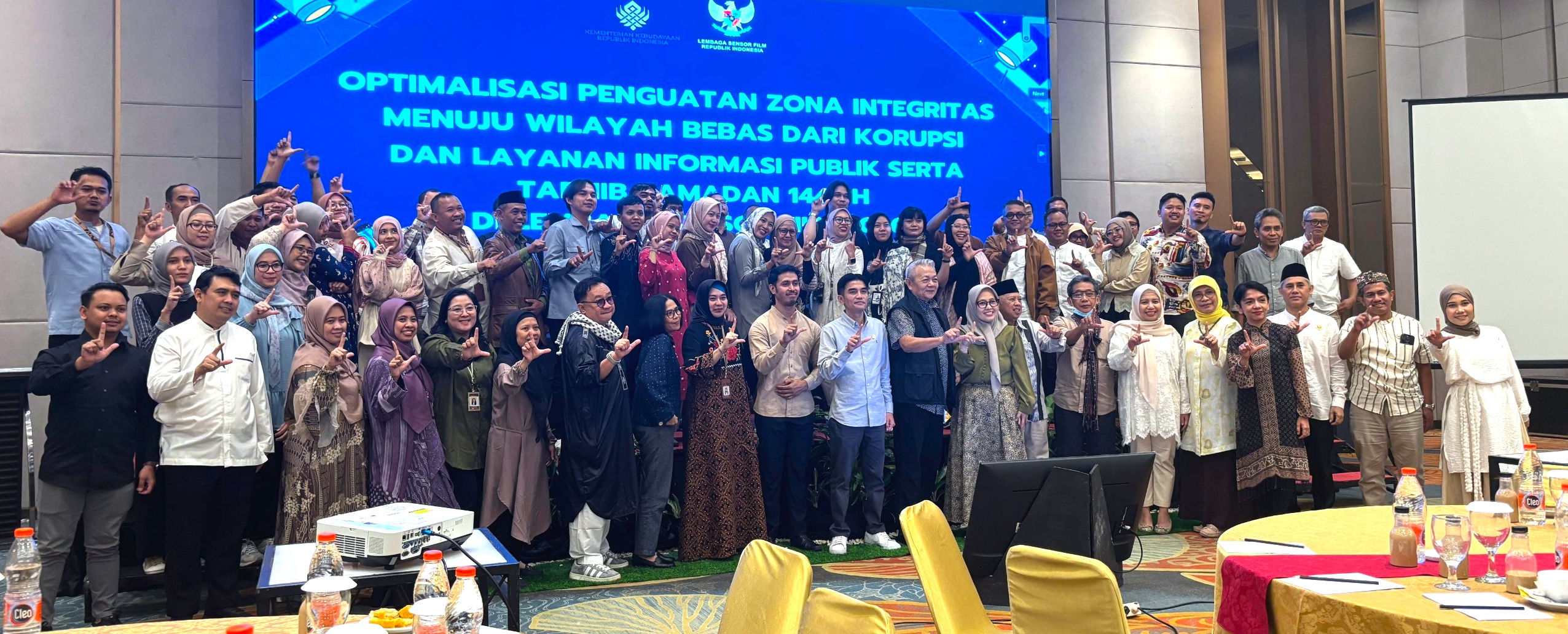
LSF Chair Naswardi explained in his remarks at the event “Strengthening the Optimization of ZI-WBK and Public Information Services” in Jakarta on Thursday (12 February 2026) that the institution is no longer focused solely on standard services, but also on inclusive services for persons with disabilities. “There is no discrimination in services for any group,” he said.
He also noted that in 2026 there are 270 national films produced by 146 production houses, but only three production houses are able to produce 10 titles in a year. According to him, this is an issue because it results in only 180 titles being screened in cinemas. “I urge that small production houses be supported,” Naswardi emphasized.
Responding to this, Chair of Commission VII of the House of Representatives, Saleh Partaonan Daulay, who attended the event held in conjunction with welcoming Ramadan 1447 H, stated that the term “limited screens” is merely a diplomatic expression for monopoly. “If one screen costs Rp4 billion, it will not happen. Those who can build screens are the same large business actors, and the capital circulates among them,” he said.
Another issue is that national films face difficulties competing with foreign films. Commission VII of the House of Representatives, which oversees industry, MSMEs, the creative economy, tourism, and public communication infrastructure, is currently examining this issue. “Therefore, there must be a national standardization body for film,” Saleh stated.
Meanwhile, Inspector General of the Ministry of Culture, Fryda Lucyana, expressed pride in the ZI-WBK award received by LSF. However, she noted that there is a higher designation above ZI-WBK, namely the Clean and Service-Oriented Bureaucracy Area (WBBM).
To achieve this, she outlined four key factors: ease of service, quality of innovation, integrity as an institutional culture, and the ability to provide programs that directly impact the public. “A good bureaucracy is one whose impact is felt by the community,” Fryda concluded. (Nuz)