
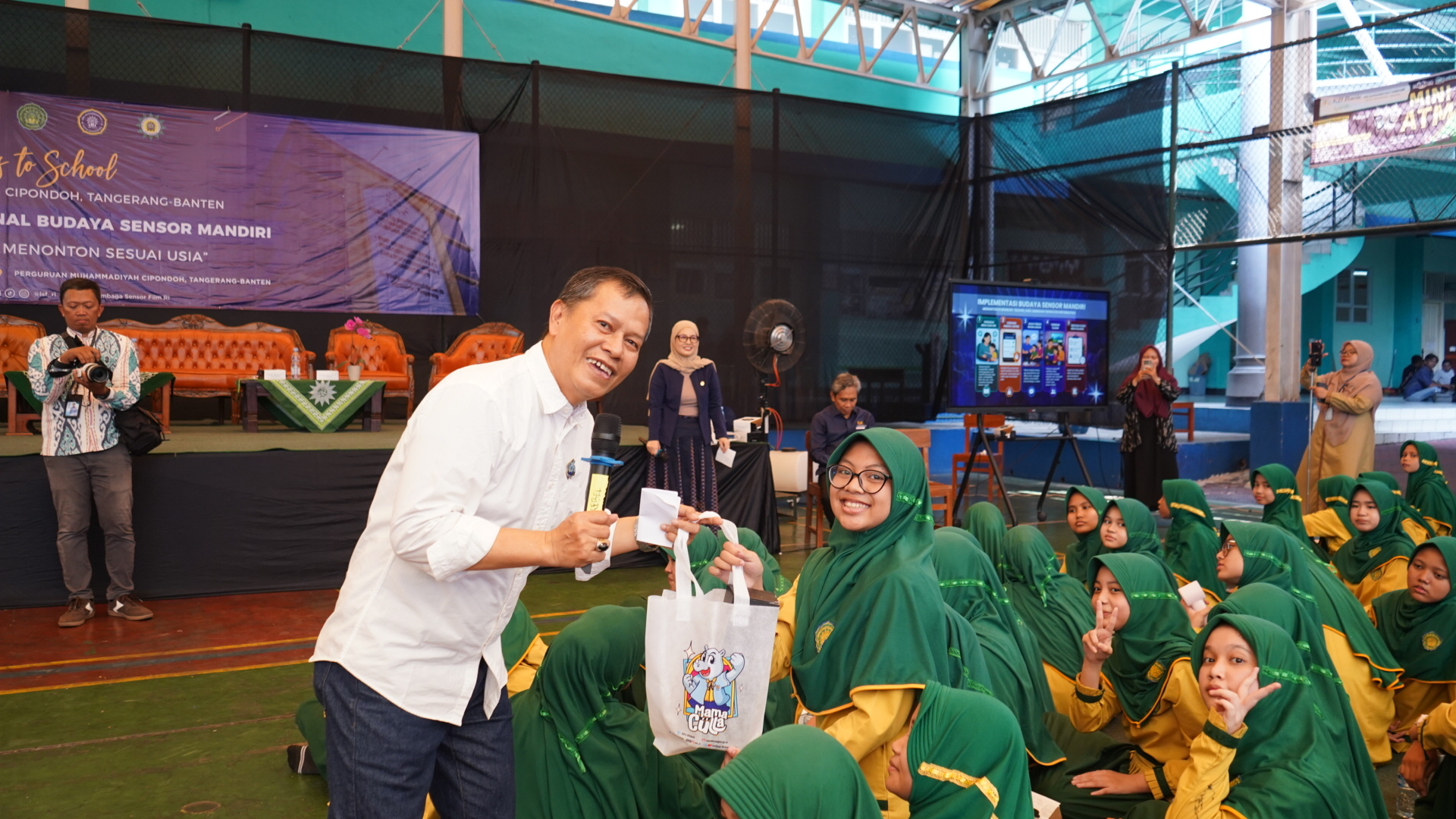
LSF Holds National Self-Censorship Movement Program at Perguruan Muhammadiyah Cipondoh
Tangerang, November 6, 2026 — To raise awareness among young people about selecting age-appropriate audiovisual content, the Film Censorship Board of Indonesia (LSF RI) held an outreach event for the National Movement for a Culture of Self-Censorship (GNBSM) at Perguruan Muhammadiyah Cipondoh, Tangerang, on Friday (November 6, 2026). The event, attended by junior high school (SMP), senior high school (SMA), and vocational high school (SMK) students, provided education on the Culture of Self-Censorship and responsible filmmaking through the promotion of the film Fatima.
LSF RI Chair Naswardi explained that efforts to keep GNBSM relevant to younger generations are carried out through direct engagement with educational institutions and communities.
“We continue to visit universities, schools, and communities to support the development of Indonesia's film industry and ensure that the public has a good understanding of responsible viewing practices through a Culture of Self-Censorship and watching films appropriate for their age,” Naswardi said.
Head of the LSF Outreach Subcommission Titin Setiawati expressed hope that the National Movement for a Culture of Self-Censorship (GNBSM) would reach more people each year. Through these activities, LSF aims to increase public awareness of the importance of self-censorship, enabling audiences to make informed decisions when selecting age-appropriate content.
Meanwhile, Fatima producer Ferly explained that creating films with meaningful messages for audiences should begin at the earliest stages of story development. This process involves data collection, surveys, and story research.
“Creating a film that is not merely commercial but also meaningful and substantial begins with collecting data, conducting surveys, and researching the story,” Ferly said.
Dita, a teacher at Perguruan Muhammadiyah Cipondoh, emphasized the school's role in educating students about film age classifications so they can select content appropriate for their age.
“The first step is education. We need to inform students that there are four film age classifications: All Ages (SU), 13+, 17+, and 21+. Each classification indicates which films are appropriate for their age group,” Dita explained.
(Adiba Syaidatun Nisa/Tin)