During a Film Law and Censorship Literacy Program in Bali, LSF Presents Several Key Points
Denpasar, June 12, 2026 — Every film and film advertisement intended for public distribution or exhibition must obtain a Film Censorship Approval Certificate (STLS) from the Film Censorship Board (LSF). This requirement is explicitly stipulated in Article 57, paragraph (1) of Law No. 33 of 2009 on Film.
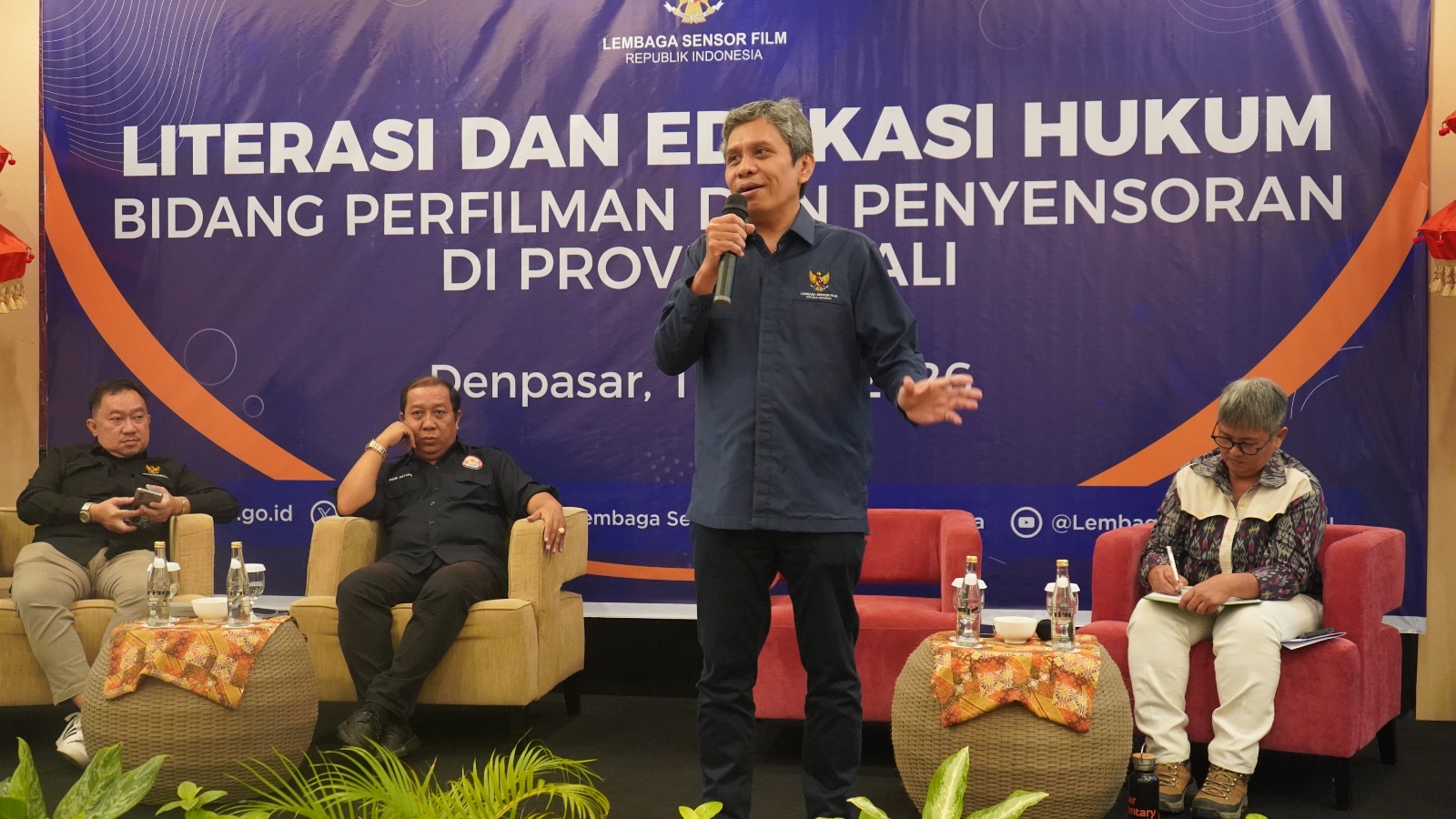
“A film that has not undergone censorship and is broadcast directly, for example on television, may become a legal issue. The Indonesian Broadcasting Commission (KPI) and Regional Broadcasting Commissions (KPID) can take follow-up action, because LSF is the only institution authorized to certify that a film is suitable for public exhibition,” said Saptari Novia Stri during the opening of the Film and Film Censorship Legal Literacy and Education program attended by local stakeholders in Denpasar, Bali, on Friday (June 12, 2026).
Saptari explained that the issuance of an STLS provides legal protection for filmmakers while ensuring that content exhibited to the public complies with prevailing social norms and values.
LSF Commission II Chair Ervan Ismail stated that the STLS serves as official assurance that a film is legally approved for distribution and appropriate for audiences according to its age classification.
“It provides legal certainty and protection. The STLS is official proof from the State, through LSF, that your film complies with Law No. 33 of 2009 on Film,” he said.
He added that the legal protection provided by LSF includes assistance and advocacy. Should public objections or controversy arise after a film is released, LSF can act as a mediator or provide expert testimony.
“LSF will advocate that the film has undergone state review and has been declared suitable for distribution,” Ervan explained.
To obtain an STLS, film owners can use the Electronic Censorship Administration System (e-SiAS), as explained by Head of the LSF Publication Subcommission Nusantara Husnul Khatim Mulkan.
Through this online platform, the entire censorship process—from account registration, film submission, and fee payment to the issuance of the STLS—can be completed remotely from anywhere in Indonesia.
“With e-SiAS, the process can be completed within a maximum of three working days. This is far more efficient. Censorship fees are also relatively affordable. For educational purposes, such as submissions from universities or senior high schools, the applicable fees are significantly lower,” Nusantara said.
Chair of the Bali Regional Indonesian Broadcasting Commission (KPID Bali), I Gede Agus Astapa, emphasized the importance of cooperation among the government, broadcasters, KPI, and the public in maintaining a healthy broadcasting environment.
“KPID Bali has demonstrated that a healthy broadcasting ecosystem is not created solely through strict supervision, but through a balance between actively fostering public awareness and taking firm action against violations of the public’s rights,” he said.
The Film Censorship Board of Indonesia (LSF RI) is a permanent and independent state institution responsible for assessing the suitability of films and film advertisements before they are distributed and/or exhibited to the public.
Film censorship is mandated under Article 57 of Law No. 33 of 2009 on Film, which requires every film and film advertisement intended for public distribution or exhibition to obtain a Film Censorship Approval Certificate (STLS) issued by LSF.
Film Censorship Board of Indonesia (LSF RI)
Website: https://lsf.go.id/
Instagram / X / TikTok: @lsf_ri
Facebook: Film Censorship Board of Indonesia
YouTube: Film Censorship Board RI
Media Contact:
Cristy: +62 811-9971-707